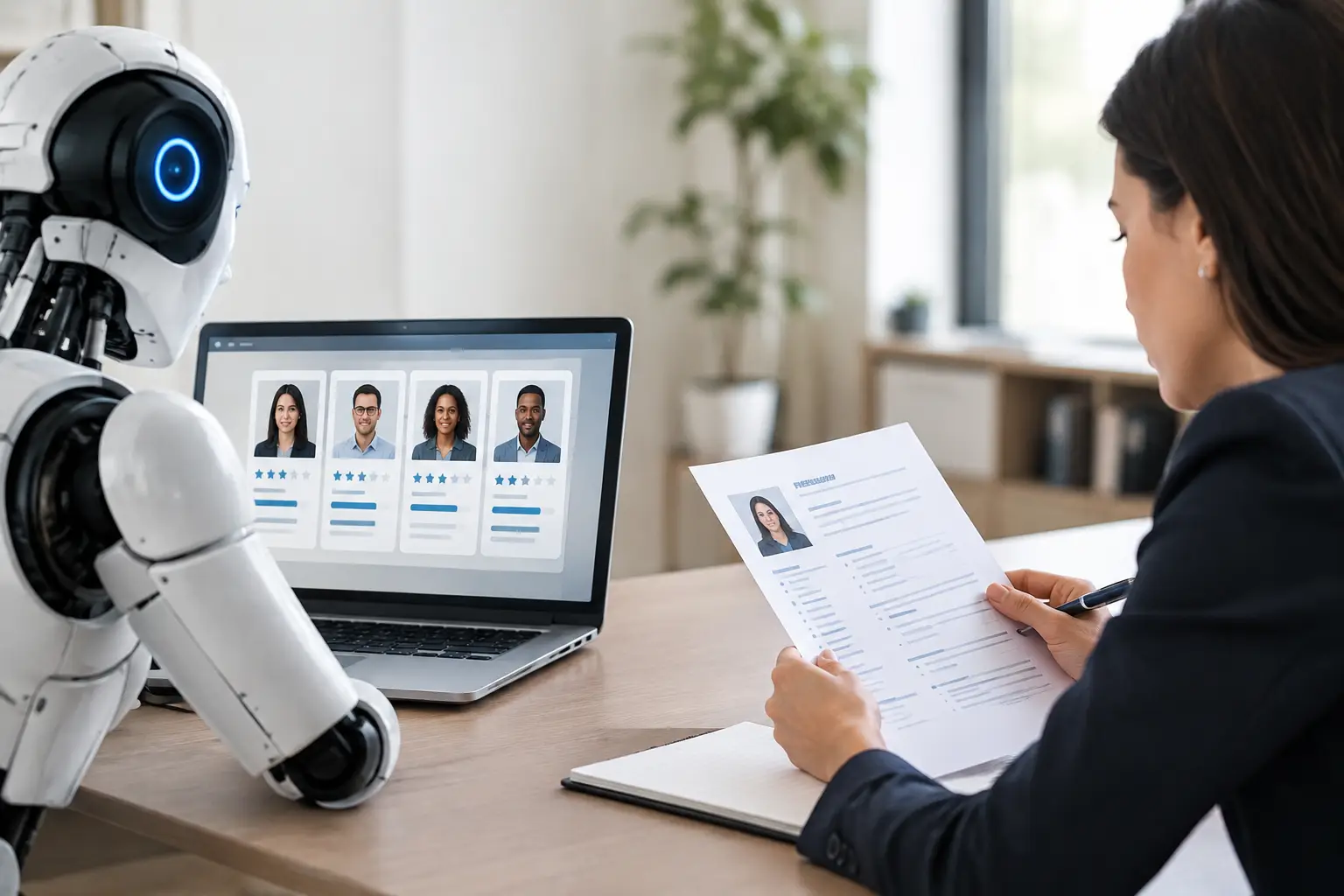
A recruiter opens a role and receives 400 applications by Friday. The challenge is not finding resumes. It is finding the evidence that separates a credible match from a polished but weak application. AI screening versus human review is not a choice between speed and judgment. It is a decision about where each should do its best work.
For hiring teams under pressure, manual review of every resume can turn a promising search into a slow, inconsistent process. Yet fully automated rejection creates a different risk: qualified people may be overlooked, and managers may lose sight of how a decision was reached. The strongest hiring model uses AI to organize, assess, and prioritize evidence, then gives people the context and authority to make the final call.
Why AI Screening Versus Human Review Is the Wrong Fight
AI and human reviewers solve different parts of the hiring problem. Screening technology is built for volume, consistency, and pattern recognition. A hiring manager is responsible for context, accountability, and the judgment that cannot be reduced to a checklist.
AI can compare applications against the requirements of a role in seconds. It can identify relevant experience, skills, qualifications, language capabilities, and responses to role-specific questions. It can apply the same evaluation structure to every candidate, which reduces the risk that the first resume reviewed receives more attention than the 200th.
Human reviewers bring something equally essential: an understanding of the team, business priorities, and the realities behind a candidate's career path. A gap in employment may reflect caregiving, retraining, or a difficult market. A nontraditional background may reveal precisely the adaptability a role requires. A hiring manager can assess whether a candidate's approach, communication, and motivation fit the work ahead.
The question is not whether AI can replace that judgment. It should not. The question is whether hiring teams should spend their limited time sorting through administrative noise before they can apply that judgment. In most cases, the answer is no.
Where AI Delivers a Clear Advantage
The value of AI begins before the first application arrives. A well-structured job opening gives the hiring process a shared standard. When required skills, preferred experience, responsibilities, and evaluation criteria are defined clearly, AI can assess candidates against the role rather than against vague impressions.
This matters because unstructured hiring creates inconsistency. One recruiter may favor a recognizable employer name. Another may focus on a single credential. A manager may prioritize interview chemistry over demonstrated capability. None of these signals is necessarily useless, but they are unreliable when used without a common framework.
AI screening can apply that framework at scale. It can score candidates based on relevant evidence, surface strengths and gaps, and rank applicants according to fit. It can also generate tailored interview questionnaires and skill assessments that test the requirements that matter for a specific position.
The operational gain is substantial. Instead of spending hours scanning similar resumes for basic alignment, recruiters can begin with a prioritized view of candidates who meet the core criteria. That does not mean the remaining applicants disappear. A transparent system should preserve full access to every profile, CV, score, and report. AI should reduce the noise, not hide the talent pool.
Consistency is not the same as certainty
A consistent score is valuable, but it is not a final truth. AI evaluates the information it receives against the criteria it is given. If a job description is poorly defined, if the scoring logic overweights one factor, or if a candidate's strongest qualities are not visible in the application, the output may be incomplete.
This is why screening results should be treated as decision support. A ranking helps a team focus. It does not excuse a team from reviewing the evidence behind that ranking.
What Human Review Must Continue to Own
Human review should not be reserved only for the offer stage. It should shape the process at the moments where judgment has the greatest impact: defining the role, validating shortlist quality, conducting meaningful interviews, and making the final selection.
Hiring managers should review the reasoning behind a candidate's score, not simply accept a rank order. If a candidate is ranked highly because of technical alignment but has limited leadership experience, that trade-off may be acceptable for one role and disqualifying for another. The business context determines the answer.
Interviews are also where human reviewers assess the dimensions that matter beyond resume fit. Can the candidate explain how they solve problems? Do they demonstrate sound judgment when priorities conflict? How do they collaborate, respond to feedback, or communicate under pressure? These are not reasons to abandon structure. They are reasons to use structured interviews that give candidates a fair opportunity to provide comparable evidence.
Human oversight is especially important when candidates have unconventional backgrounds. A military transition, a career pivot, freelance work, international experience, or a nonlinear education path may not fit conventional resume patterns. An experienced reviewer can see transferable capability that a narrow screening rule may miss.
Build a Hiring Workflow Where AI Advises and Humans Decide
The most effective workflow does not place automation and human judgment in separate stages with no connection between them. It creates a clear handoff from data-driven screening to manager-led evaluation.
Start by defining the role with precision. Separate nonnegotiable requirements from preferred qualifications. If everything is labeled essential, the screening process becomes too rigid and the shortlist becomes less useful. Teams should agree on what must be true on day one, what can be learned, and what success looks like after six or twelve months.
Next, use AI to screen and score applicants against those criteria. The system should provide more than a yes-or-no result. Recruiters and managers need a clear view of each candidate's evidence, relevant experience, assessment results, and identified gaps. Explainability is practical, not optional. A score without context does not support a defensible hiring decision.
Then, focus human time on a manageable finalist group. BeeXpro HR's BXP engine, for example, presents a ranked Top 5 of best-matching candidates while keeping every applicant visible and available for review. This gives hiring teams a faster route to meaningful final-round conversations without turning the algorithm into a gatekeeper.
Finally, use structured interviews and role-specific assessments to validate the shortlist. The interview should test the areas that the resume and AI analysis cannot fully confirm. For a sales role, that may mean discovery skills and objection handling. For an operations leader, it may mean prioritization and process judgment. For a technical hire, it may mean explaining trade-offs rather than only producing a correct answer.
Protect Against the Risks of Over-Automation
AI can improve consistency, but only when the process around it is designed responsibly. Hiring teams should regularly review whether their criteria reflect real job requirements, whether candidate rankings align with later interview outcomes, and whether any group is being disproportionately filtered out without a job-related reason.
They should also maintain a review path for candidates who may warrant another look. A candidate with missing keywords is not automatically a poor fit. Keyword matching alone is a weak hiring strategy because it rewards resume optimization, not necessarily capability. Strong systems consider broader evidence, while people retain the ability to question the result.
Transparency matters internally as well. Recruiters should be able to explain to hiring managers why candidates were prioritized. Hiring managers should understand what a score measures and what it does not. When a candidate asks about the process, the organization should be able to describe it honestly: technology supported the evaluation, but a person made the decision.
The Better Standard for Hiring Teams
The best measure of a screening process is not how many resumes it rejects or how quickly it fills a pipeline. It is whether the team reaches stronger, more informed decisions with less wasted effort.
AI is highly effective at processing applications, applying defined criteria, and bringing the most relevant evidence into view. Human reviewers are indispensable for interpreting that evidence, recognizing potential, and taking responsibility for the final choice. Treating either as sufficient on its own creates avoidable blind spots.
Give AI the work of sorting complexity. Give people the work of deciding what matters. That is how hiring teams move faster without lowering the standard for the people they bring in.