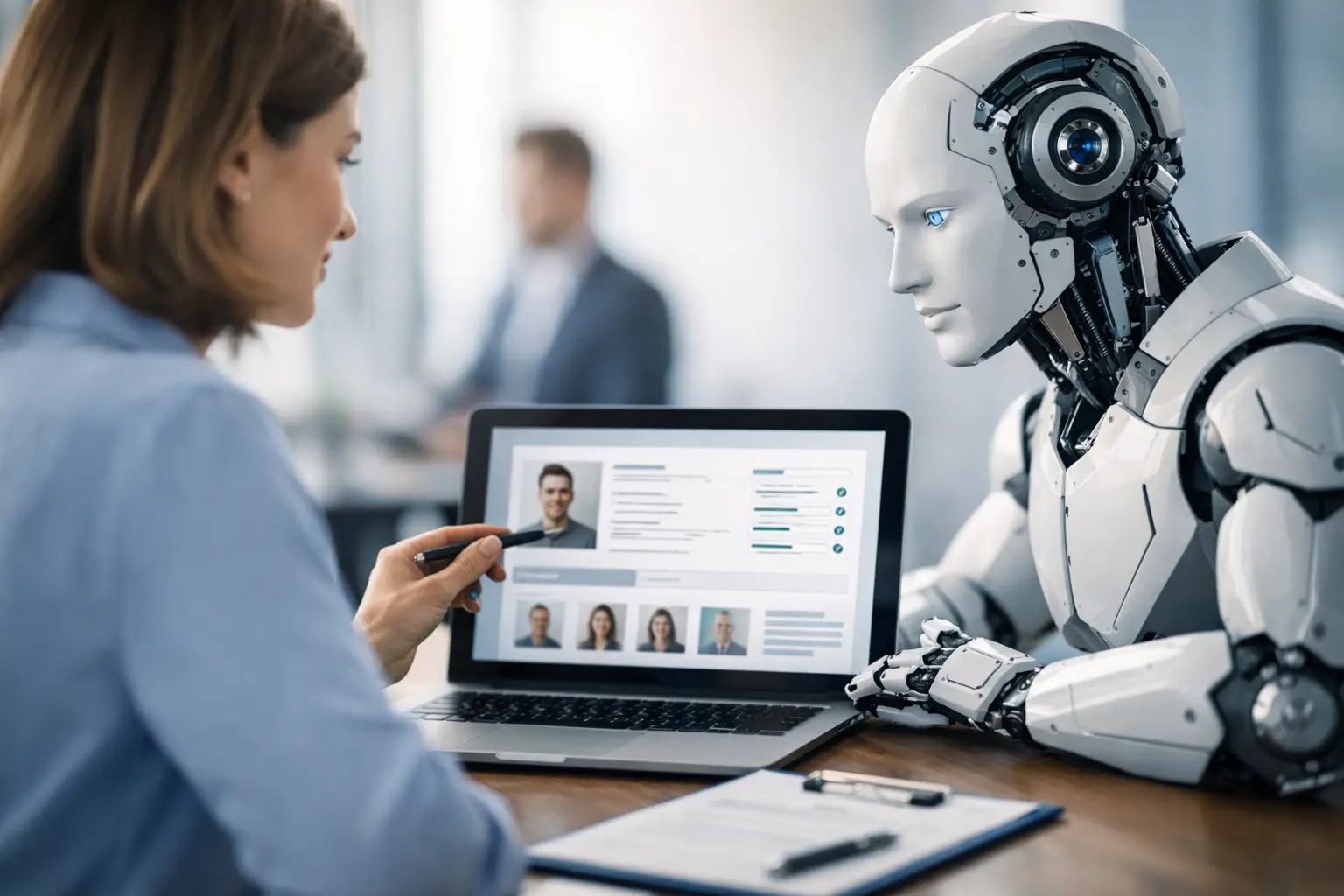
A hiring manager with 300 applications for one role does not have a candidate problem. They have a filtering problem. That is where human in the loop hiring AI becomes useful - not as a replacement for judgment, but as a way to remove noise, structure evaluation, and let people focus on the candidates most worth serious attention.
For most teams, the issue is not access to talent. It is the volume of signals, the inconsistency of reviews, and the time required to compare candidates fairly. Recruiters scan resumes differently. Hiring managers prioritize different traits. Interviews vary by interviewer, by day, and sometimes by mood. Good people get missed, weak fits move forward, and hiring slows down.
A human-in-the-loop model is designed to solve exactly that. AI handles repeatable, data-heavy work at scale, while humans make the final decision. That distinction matters. It improves speed and consistency without handing over responsibility for one of the most consequential decisions a company makes.
What human in the loop hiring AI actually means
Human in the loop hiring AI is a hiring model where AI supports screening, scoring, assessment, and interview workflows, but people remain actively involved in reviewing outputs and deciding who advances and who gets hired.
That sounds straightforward, but the difference between support and control is where many systems fail. If AI acts like a black box gatekeeper, teams lose transparency and trust. If it only adds surface-level automation, it does not reduce enough manual effort to matter. The right model sits in the middle. AI should do the heavy analytical work, then present structured results that a hiring manager can inspect, challenge, and act on.
This is especially valuable in high-volume hiring or when teams are hiring across multiple roles, locations, or languages. Standardized analysis helps reduce random variation. Human review ensures context is not lost.
Why fully automated hiring breaks down
The appeal of full automation is obvious. Faster screening, lower admin time, and cleaner workflows. But hiring is not a pure pattern-matching exercise.
Candidates are not identical data objects. Career paths are uneven. Strong people often present imperfectly on paper. Some bring transferable skills that do not fit rigid keyword logic. Others interview well but may not match the role's actual requirements. If a system is allowed to decide without oversight, those edge cases become losses.
There is also the issue of accountability. Leaders may accept AI assistance, but they still expect a person to stand behind a hiring decision. When a hire fails, no one wants the explanation to be, the algorithm said yes.
That is why human oversight is not a compliance checkbox. It is an operating requirement. AI can improve the process, but it cannot own the outcome.
Where AI adds the most value in a human-led hiring process
The strongest use of hiring AI is not at the final decision point. It is earlier, where the workload is repetitive and the opportunity for structure is highest.
Resume screening is the clearest example. Instead of forcing recruiters to read every application from scratch, AI can analyze CVs against role criteria, identify likely matches, and rank candidates based on fit signals. That does not mean the ranked list should be blindly accepted. It means the first review starts from an informed shortlist rather than a raw pile of resumes.
The same applies to candidate scoring. When scoring is automated against predefined requirements, teams get more consistency. They can compare candidates on common dimensions instead of relying on fragmented notes and memory. The trade-off is that scoring models need strong inputs. If the role is poorly defined, the output will reflect that.
Interview preparation is another high-value area. AI can generate tailored interview questions based on the position, seniority level, and candidate background. This improves structure without forcing interviewers into robotic scripts. It gives hiring teams a stronger starting point and helps reduce the usual variation between interviewers.
Skill assessments and multilingual interviews are also natural fits. AI can create role-relevant evaluations and process candidate responses at scale, which is difficult for lean teams to do manually. In global hiring, multilingual capability is not a nice extra. It is a practical advantage that helps teams compare candidates more consistently across regions.
What a strong human in the loop workflow looks like
A strong model is transparent from the first step. The role is clearly structured, the evaluation criteria are defined, and the AI is trained to work against those criteria. Candidates are then screened, scored, and organized based on measurable relevance.
From there, human reviewers step in at the points where judgment matters most. They review the strongest matches, inspect the reasoning behind rankings, compare profiles, and decide who should move into deeper evaluation. They do not need to manually sort through every application to get there, but they are never blocked from seeing the full field.
That visibility is critical. If hiring managers can only see the AI's finalists, they cannot validate whether strong candidates were missed. A better system surfaces top matches clearly while preserving access to all applicants, all profiles, and all documentation.
This is where BeeXpro HR's approach reflects the model well. Its BXP engine handles the analytical work across job creation, CV screening, scoring, interview question generation, skill assessments, and real-time multilingual interviews, then presents hiring managers with a ranked Top 5 of the best-matching candidates. At the same time, teams keep full visibility into every applicant, with access to profiles, downloadable CVs, and exportable reports. The AI narrows focus. The human still decides.
The operational benefits are real - if the process is designed well
For hiring teams, the first gain is time. Not theoretical time savings, but fewer hours spent scanning resumes, rewriting interview guides, coordinating fragmented evaluations, and reconciling inconsistent feedback.
The second gain is consistency. When every candidate is reviewed against the same structured criteria, decision quality improves. This does not eliminate disagreement, and it should not. Different decision-makers may still value different traits. But those discussions become more grounded because they are happening on top of shared data, not scattered impressions.
The third gain is focus. A hiring manager should spend the bulk of their time on the finalists most likely to succeed, not on administrative triage. Human in the loop hiring AI helps shift effort toward higher-value evaluation.
Still, results depend on implementation. If the AI is fed vague job descriptions, weak scoring logic, or irrelevant assessment criteria, the workflow becomes faster without becoming smarter. Better automation starts with better hiring design.
What decision-makers should ask before adopting hiring AI
The key question is not whether the platform uses AI. That is too broad to be useful. The real question is how the system supports human judgment.
Can your team see why candidates were ranked a certain way? Can managers review all applicants, not just a filtered shortlist? Can the workflow adapt to different roles, hiring volumes, and languages? Does the system improve interview quality, or just automate scheduling and screening? Most importantly, does the technology help people make better final decisions, or does it push them toward passive acceptance of machine outputs?
It also helps to be realistic about your own hiring environment. A startup hiring a few generalists needs flexibility and speed. A larger organization may need stronger process control, reporting, and consistency across departments. The right human-in-the-loop system should scale across both situations without forcing the same workflow on every role.
Human in the loop hiring AI is not slower. It is more precise.
Some teams worry that keeping humans involved reduces the efficiency gains of AI. In practice, the opposite is often true. Removing people entirely creates trust issues, review bottlenecks, and poor-fit decisions that are expensive to fix later.
A better process uses AI to compress the low-value work and reserve human attention for evaluation, comparison, and final choice. That is not slower. It is more precise.
Hiring works best when technology improves the quality of human judgment rather than trying to replace it. The companies that build around that principle will move faster, hire with more consistency, and still keep the decision where it belongs - with people who understand the role, the team, and the stakes.