HR processes rarely become complicated overnight.
First there are a few CVs in the inbox. Then a spreadsheet of candidates. Then another spreadsheet for annual leave. Employee documents sit in folders, candidate statuses live in emails, interview notes are scattered across different people, and the information management needs has to be pulled together by hand from several sources.
While the team is small, this way of working can hold up.
The trouble starts when the company begins to grow.
At that point, the question is no longer whether HR needs one more spreadsheet.
The question is: is there a better way to manage the whole process?
That's where modern HR software starts to pay off.
What is HR software?
HR software is a digital platform that helps companies organise, automate and track the processes tied to candidates and employees.
Depending on the system, it can cover:
- creating and publishing job openings
- receiving candidate applications
- reviewing and screening CVs
- candidate management
- interviews and evaluations
- job offers and paperwork
- onboarding new employees
- employee records
- annual leave and absences
- business travel
- HR documentation
- employee goals and performance reviews
- organisational structure
- HR reporting
The real value isn't that HR gets yet another digital tool.
The value appears when information, people and processes finally work together.
Why Excel and email stop being enough
Excel isn't a bad tool.
Email isn't the problem either.
The problem starts when we try to use them for a job they were never designed to do.
Picture a company hiring for five roles at once.
Every position brings applications, CVs, referrals and messages. Several people take part in interviews. Someone has to keep track of who has been contacted, who is waiting for an interview, who needs a reply and who has been approved for the next step.
If a candidate is hired, a whole new process begins.
Documents have to be collected, onboarding prepared, an employee profile created, data recorded and the new starter brought into internal HR processes.
In a manual system, a large part of that information gets entered all over again.
Modern HR software is designed to remove exactly those breaks in the process.
A candidate shouldn't have to disappear from one system in order to reappear as an employee in another.
ATS, HRIS and HR software — what's the difference?
These terms are often used side by side, but they don't mean quite the same thing.
ATS — Applicant Tracking System
An ATS is built primarily for recruitment.
It helps you organise open positions, applications, CVs, screening, interviews, evaluations and the hiring pipeline.
Its focus is the journey:
open position → candidate → interview → offer → hire
If you'd like to understand the ATS in more detail, read our guide What is an ATS and when does your HR team really need one?
HRIS — Human Resources Information System
An HRIS deals primarily with employees after they've been hired.
It typically holds employee data, documentation, organisational structure, absences, onboarding, reviews and other HR processes.
Its focus begins where a classic ATS often ends.
The modern HR platform
That's why more and more companies are looking for a system in which recruitment and employee management aren't two entirely separate worlds.
It makes for a simpler journey:
candidate → employee → employee development
without unnecessary data exports, re-entry and parallel databases.
7 signs a company has outgrown manual HR
Not every company needs a large HR system from day one.
But there are very clear signs that the current way of working is no longer enough.
1. Data lives in too many places
Part of it is in Excel.
Part of it is in email.
Documents are in the cloud.
Interview notes may be sitting in the hiring manager's private document.
When nobody has the full picture, the risk of mistakes and lost information grows.
2. You can't tell at a glance what stage each candidate is at
If answering "what's happening with this candidate?" means asking several people, the hiring process isn't transparent enough.
3. HR spends too much time on admin
Sending the same messages.
Updating statuses.
Retyping data.
Hunting for documents.
Arranging meeting times.
Admin is necessary, but it shouldn't eat up the time HR could be spending talking to candidates and employees.
4. Several people are involved in hiring
The recruiter, HR manager, director and department head all need to see the same process and have access to the relevant information.
Without a central system, competing versions of the truth appear fast.
5. The company hires across several cities or countries
As an organisation spreads geographically, complexity grows with it.
Teams, responsibilities, languages, locations and different HR processes all have to stay clear and visible.
6. A candidate becomes an employee — and everything starts from scratch
If, once someone is hired, you're re-entering their basic details into another system, the process is fragmented for no good reason.
7. You don't have reliable HR data
How long does hiring take?
How many candidates make it through each stage?
Where does the process slow down?
Which absences are currently active?
Which documents are missing?
Without structured data, it's hard to make structured decisions.
What should good HR software offer?
Counting features isn't the best way to compare HR platforms.
The more useful question is:
How many of your team's real problems does the system actually solve?
Centralised data
A candidate or employee should have one clear profile holding the relevant information, documents, activity and history.
A clear recruitment pipeline
HR and the hiring manager should immediately see who has applied, who has passed screening, who is waiting for an interview and who needs an offer.
Structured candidate evaluation
A good system lets candidates be evaluated against defined criteria.
That way, decisions rely less on disconnected notes and one person's subjective impression.
Automation of repetitive tasks
Technology delivers the most value when it removes work people don't need to repeat by hand.
Statuses, certain types of communication, reminders, data organisation and other administrative steps can be simplified considerably.
Onboarding
Hiring doesn't end when the offer is accepted.
That's the point at which the new employee actually joins the company.
Onboarding should therefore be a natural continuation of the recruitment process, not a completely separate administrative procedure.
Employee management
Central employee records, documents, absences, organisational structure, travel, goals and reviews should all be available without the need for parallel spreadsheets.
Reporting
A good HR system isn't just a place to store data.
It should help the company understand what's going on.
Where does AI fit into modern HR?
Artificial intelligence can significantly change the early stages of hiring.
With a high volume of applications, a recruiter traditionally has to open CV after CV and manually look for the relevant information.
AI can help with tasks such as:
- CV analysis
- identifying relevant experience and skills
- comparing candidates against the criteria for a role
- structuring the screening process
- preparing interview questions
- analysing information gathered throughout the process
But there's an important line to draw.
AI should help people make a better decision — not take people out of the decision.
The greatest value of AI in HR isn't that it will "hire someone for you".
The value is that it takes a share of the slow, repetitive work off the HR team and frees up more time for conversations, judgement and people.
What does a simpler hiring process look like?
A good recruitment process doesn't need dozens of steps.
It can look like this:
1. Open the position
Define the role, responsibilities, criteria and expectations.
2. Publish the job
Candidates get a clear advert and a straightforward way to apply.
3. Applications land in a single system
No manually gathering CVs from different sources.
4. Screening organises the applications
Relevant information becomes easier to see, and the team can prioritise the candidates it wants to review in more depth.
5. Run structured interviews
Questions, notes and scores stay attached to the candidate.
6. Make the decision and send the offer
Documents and earlier stages of the process remain available.
7. Turn the candidate into an employee
Without creating a brand-new profile and re-entering the same information.
Simple.
Because hiring doesn't have to be complicated.
How BeeXpro HR connects recruitment and HR
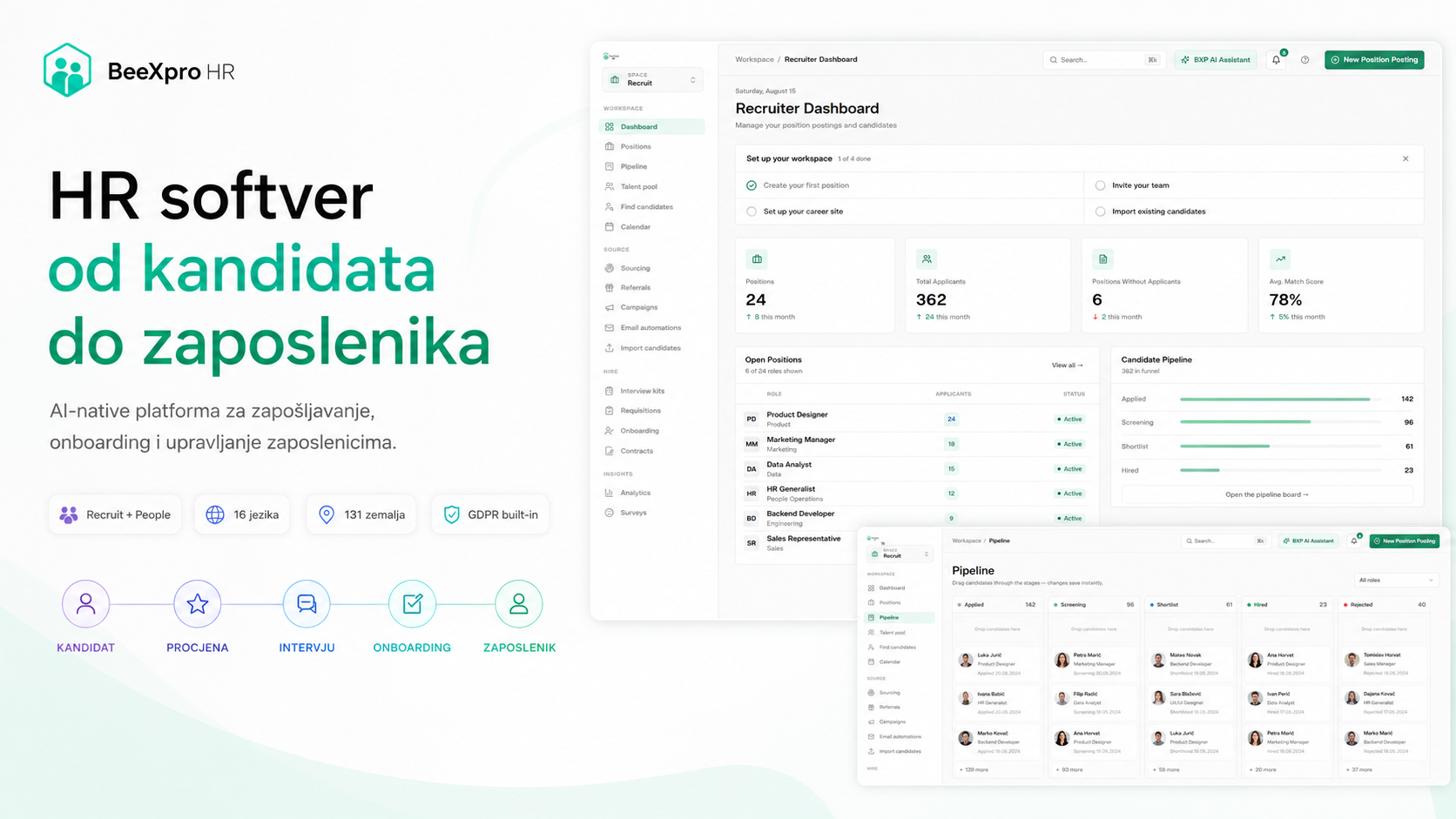
BeeXpro HR was built around the idea that hiring and employee management should be parts of the same process.
That's why the platform has two connected spaces:
BeeXpro Recruit for the hiring process.
BeeXpro People for employee management.
Recruit covers stages such as opening a position, candidate applications, AI-supported screening, pipeline management, interviews, evaluations and offers.
Once a candidate is hired, their journey can continue in People — without HR having to rebuild their profile from scratch.
People then covers areas such as onboarding, employee documentation, absences, business travel, organisational structure, compensation, goals and reviews.
The result isn't yet another HR tool.
The aim is one place for the journey from candidate to employee.
HR software for small and medium-sized companies
There's a common assumption that HR software is only for large corporations.
In practice, it's often the smaller teams that need simplicity the most.
A large company can have several recruiters, HR administrators and specialists dedicated to different processes.
In a company of 20, 50 or 100 employees, the same person often runs several HR activities at once.
That kind of team doesn't need complexity for its own sake.
It needs a tool that reduces the amount of manual work.
So when choosing HR software, the key question isn't:
How many features does it have?
A better question is:
How much time will it give us back?
How to choose HR software
Before you decide, run a simple test.
Ask a potential supplier these ten questions:
- Can we manage the entire hiring process in one place?
- Can several team members collaborate on the same position?
- Can we evaluate candidates in a structured way?
- Which administrative steps can be automated?
- What happens to a candidate's data once we hire them?
- Does the system support onboarding?
- Can we manage documents, absences and other HR processes?
- Can the system handle multiple teams, locations or countries?
- How are user access and data protection organised?
- How easy is the system for HR, managers and employees to use?
If a basic process still requires several disconnected products, extra spreadsheets and a lot of manual work, the digitalisation isn't finished.
You've simply moved the admin onto a screen.
The best HR software isn't the one with the most features
HR technology can easily become an end in itself.
More dashboards.
More options.
More configuration.
One more tool.
But HR doesn't need more software.
It needs less friction.
A good HR system should make it possible for:
- candidates to move through the process more easily
- recruiters to find relevant information faster
- hiring managers to see clearly what they need to do
- new employees to join the organisation smoothly
- HR to have tidy, accessible data
- management to get a better overview
- people to spend less time on admin
That's the real measure of HR digitalisation.
From candidate to employee, without the unnecessary steps
Modern HR is no longer a collection of isolated administrative processes.
Recruitment shapes onboarding.
Onboarding shapes the employee experience.
Documentation, goals, reviews and development are all part of the same employee journey.
It only makes sense for technology to connect them.
BeeXpro HR brings together Recruit and People so that companies can run hiring and employee management through one connected platform.
Less retyping.
Less hunting for information.
Less admin.
More time for the decisions that need people.
Because HR can be simpler.
Want to see what that looks like in practice?
Try BeeXpro HR and see how you can connect job posting, candidate screening, interviews, offers, onboarding and employee management in a single system.
Try BeeXpro HR →
Frequently asked questions about HR software
What is HR software?
HR software is a digital system for organising and automating the processes tied to candidates and employees. It can include recruitment, onboarding, employee records, documentation, absences, reviews and other HR processes.
What's the difference between an ATS and an HRIS?
An ATS is built primarily for the hiring process and candidate management. An HRIS focuses on managing employee data and processes. An integrated HR platform can connect both.
What is recruitment software?
Recruitment software helps companies manage open positions, applications, CVs, screening, interviews, evaluations and job offers. This kind of system is often called an ATS.
Does a small company need HR software?
Company size isn't the only criterion. HR software can be useful as soon as manual processes, spreadsheets, emails and disconnected documents start taking up significant time or making the process harder to see clearly.
Can AI help with hiring?
Yes. AI can help analyse applications, structure information, compare candidate profiles against a role's criteria and support screening and interviews. The final hiring decision should still rest with people.
What does HRIS stand for?
HRIS stands for Human Resources Information System. It's a system for managing information and processes relating to employees.
How do you digitalise HR processes?
Start by identifying the processes that create the most admin or the most fragmented data, then choose a system that can connect them. The goal isn't simply to replace paper with a digital document, but to reduce manual steps and create a single source of data.
Which HR software should you choose?
The best HR software depends on your organisation's needs. When choosing, assess recruitment, onboarding, employee records, automation, reporting, security, ease of use and the ability to connect recruitment with employee management.